
This Women’s History Month, PICO California is proud to uplift the voices of women leaders and organizers across our network who are building stronger, more connected communities rooted in justice, faith, and belonging. Through this Q&A, these women reflect on what called them into organizing work, how their lived experiences shape their leadership, and what “People Power” looks like in everyday life. Their stories remind us that meaningful change begins when ordinary people come together with courage, compassion, and a commitment to one another.
Q&A: Women Leading Change Across California
Amy Campbell-Blair
Organizing Director at True North Organizing Network
What called you into this work, and how have your personal values shaped the way you lead, organize, and build community over time?
What called me into this work was the desire to create a better world for my children and my community. Personally, I put a high value on kindness, justice, and time. In a world filled with all kinds of oppression, being kind is always a good thing; but that doesn’t mean accepting actions that perpetrate harm. I believe that we have to build and organize our communities with a justice mindset that is about creating spaces for everyone to belong and access to what they need. And with that in mind, time is our most valuable resource, because I refuse to waste any more of it trying to serve the status quo that only benefits a minority who rely on stolen labor.
What does “People Power” look like in everyday life, and what legacy do you hope to leave for the next generation of women stepping into this work?
“People Power” looks like the women who make up the leadership base that I work with; women who hold every community role imaginable. The women who bring their children to meetings so that they can conspire with other women to make policy changes, pursue resources, and talk about their strategies for building power. The women who cook meals for their community, transport their neighbors to their immigration status appointments, and come together when another family needs support. The women who refuse to accept that things have just always been this way and they can never change. The women who are brave enough to dream a different world into existence.
I’m trying to plant the seeds now for a different future where our patriarchal systems can no longer lie to, oppress, and weaponize women, queer folks, and men against themselves and their communities because, in that future, all of us have been able to chase healing from the expectations that have kept us apart because of twisted ideas of what it means to have and wield power.
Reverend Dana Gill
Environmental Justice and Economic Resilience Organizer at True North Organizing Network
What called you into this work, and how have your personal values shaped the way you lead, organize, and build community over time?
I went into ministry to serve people and build community in which everyone could feel a place of belonging, largely because I came from a place in which I felt like I had nowhere to belong, especially as a queer woman. It is my faith rooted in Liberation Theology, combined with my past experiences, that has me yearning for freedom from oppressive power over others, not just for myself but for everyone in my community and beyond. While I struggled with powerlessness, I also recognize the privilege that I have that I can use as a catalyst for change. And, I can’t speak to these issues without also giving a huge nod to my mentors who have poured into me and helped shape me into the person I am today.
What does “People Power” look like in everyday life, and what legacy do you hope to leave for the next generation of women stepping into this work?
Women are so often taught not to step into their full power, especially around faith and politics. People power looks like community — cooking, dancing, weeping, laughing… and when we do that in a healthy way, we are able to refine ourselves in the crucible of community and dismantle the things that hold us, especially women, back from being our full, authentic selves. My hope is that we keep deconstructing the toxic forms of community so that future generations can thrive and grow in wholeness.
Maribel Arizmendiz
Community Organizer at Sacramento ACT
What called you into this work, and how have your personal values shaped the way you lead, organize, and build community over time?
I was blessed with a privileged life in the Philippines amid stark inequality and taught a truth that has never left me: to whom much is given, much is required. I came to America in 2001 chasing the American dream, focused on building, acquiring, and achieving — until the pandemic stripped away that illusion of control and left me searching for something deeper. In that period of uncertainty, I turned to my Catholic faith for purpose and direction, and God answered by leading me to SacACT. Now, with Christ at the center and my community beside me, I am committed to turning gratitude into action: building a more just and equitable world, and in doing so, helping bring about His kingdom on earth.
What does “People Power” look like in everyday life, and what legacy do you hope to leave for the next generation of women stepping into this work?
The phrase “People Power” has an especially poignant meaning for me. We coined that phrase in the Philippines in 1986 when ordinary Filipinos overthrew a dictator (Marcos) through nonviolent means and sparked movements around the world. I was 20, a student leader, standing before tanks and soldiers with nothing but faith and solidarity with my fellow Filipinos. I didn’t just witness history — I helped make it. Most importantly, I survived the fascist regime and lived to tell the tale. (Coincidentally, today, Feb. 25, marks the 40th anniversary of People Power in the Philippines.)
To the next generation of women and to the community in general, my advice is: Step out of your comfort zone and be the change you want to see. And to anyone feeling hopeless: don’t. Ordinary people can do extraordinary things. Find your “power coat” and wear it proudly — especially at this moment we are in. But never forget — real change demands collective strength. It takes organized, united people power to overcome raw, unchecked power.
Tia Barnes
Organizer at Faith in the Valley
Reflection on Leadership and Community
“We are leading from proximity, not perfection. More folks are realizing that leadership doesn’t require a platform — it starts with taking responsibility for what’s right in front of you. A conversation, a room, a community is all we need; it’s all we have ever needed to start to change things. I see the people redefining leadership as a collective rather than an individual’s job to do.
Leadership today looks like many hands, many voices, and shared responsibility. It’s less about being chosen, and more about choosing to show up.”
En Español
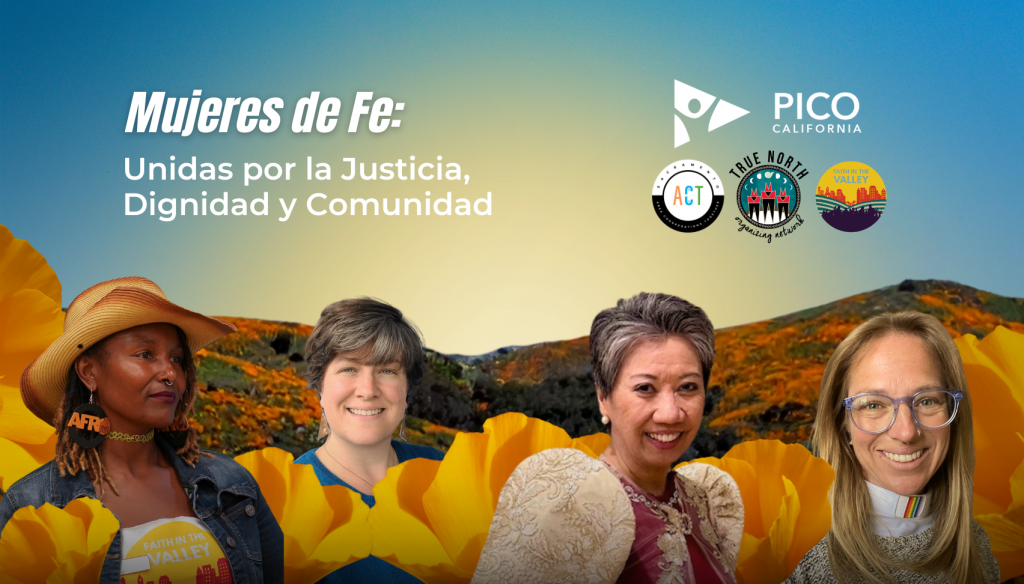
Mes de la Historia de la Mujer: Mujeres Liderando con Fe, Valentía y Poder Popular
Preguntas y Respuestas: Mujeres Liderando el Cambio en California
Amy Campbell-Blair
Directora de Organización en True North Organizing Network
¿Qué te llamó a este trabajo y cómo han influido tus valores personales en la manera en que lideras, organizas y construyes comunidad con el paso del tiempo?
Lo que me llamó a este trabajo fue el deseo de crear un mundo mejor para mis hijos y para mi comunidad. Personalmente, valoro profundamente la bondad, la justicia y el tiempo. En un mundo lleno de diferentes formas de opresión, ser amable siempre es algo bueno; pero eso no significa aceptar acciones que perpetúan el daño. Creo que debemos construir y organizar nuestras comunidades desde una mentalidad de justicia, creando espacios donde todas las personas puedan pertenecer y tener acceso a lo que necesitan. Y con eso en mente, el tiempo es nuestro recurso más valioso, porque me niego a seguir desperdiciándolo sirviendo a un sistema que solo beneficia a una minoría que depende del trabajo robado.
¿Cómo se ve el “Poder Popular” en la vida cotidiana y qué legado esperas dejar para la próxima generación de mujeres que están entrando a este trabajo?
El “Poder Popular” se ve en las mujeres que forman la base de liderazgo con la que trabajo; mujeres que ocupan todo tipo de roles dentro de sus comunidades. Mujeres que llevan a sus hijos a las reuniones para conspirar junto a otras mujeres sobre cómo impulsar cambios en políticas públicas, conseguir recursos y compartir estrategias para construir poder. Mujeres que preparan comida para su comunidad, llevan a sus vecinos a sus citas migratorias y se unen cuando una familia necesita apoyo. Mujeres que se niegan a aceptar que las cosas “siempre han sido así” y que no pueden cambiar. Mujeres lo suficientemente valientes como para imaginar y crear un mundo diferente.
Estoy tratando de sembrar las semillas para un futuro distinto, donde nuestros sistemas patriarcales ya no puedan mentir, oprimir ni usar como arma a las mujeres, las personas queer y los hombres contra sí mismos y sus comunidades, porque en ese futuro todas y todos habremos podido sanar de las expectativas que nos han mantenido separados debido a ideas distorsionadas sobre lo que significa tener y ejercer poder.
Reverend Dana Gill
Organizadora de Justicia Ambiental y Resiliencia Económica en True North Organizing Network
¿Qué te llamó a este trabajo y cómo han influido tus valores personales en la manera en que lideras, organizas y construyes comunidad con el paso del tiempo?
Entré al ministerio para servir a las personas y construir comunidad donde todas y todos pudieran sentir un lugar de pertenencia, en gran parte porque yo venía de un lugar donde sentía que no pertenecía, especialmente como mujer queer. Es mi fe, arraigada en la Teología de la Liberación, combinada con mis experiencias de vida, la que me hace anhelar la libertad frente al poder opresivo sobre otras personas, no solo para mí sino para toda mi comunidad y más allá. Aunque luché con sentimientos de impotencia, también reconozco el privilegio que tengo y cómo puedo usarlo como un catalizador para el cambio. Y no puedo hablar de estos temas sin reconocer también a mis mentores, quienes han invertido en mí y ayudado a formarme en la persona que soy hoy.
¿Cómo se ve el “Poder Popular” en la vida cotidiana y qué legado esperas dejar para la próxima generación de mujeres que están entrando a este trabajo?
A las mujeres muchas veces se nos enseña a no ocupar plenamente nuestro poder, especialmente en temas de fe y política. El poder popular se ve en la comunidad: cocinar, bailar, llorar, reír… y cuando hacemos eso de una manera sana, podemos transformarnos dentro de la comunidad y desmontar las cosas que nos impiden —especialmente a las mujeres— ser nuestro yo más auténtico. Mi esperanza es que sigamos deconstruyendo las formas tóxicas de comunidad para que las futuras generaciones puedan crecer y prosperar en plenitud.
Maribel Arizmendiz
Organizadora Comunitaria en Sacramento ACT
¿Qué te llamó a este trabajo y cómo han influido tus valores personales en la manera en que lideras, organizas y construyes comunidad con el paso del tiempo?
Fui bendecida con una vida privilegiada en Filipinas, en medio de profundas desigualdades, y crecí con una verdad que nunca me ha abandonado: a quien mucho se le da, mucho se le exige. Llegué a Estados Unidos en 2001 persiguiendo el sueño americano, enfocada en construir, adquirir y lograr metas, hasta que la pandemia despojó esa ilusión de control y me dejó buscando algo más profundo. En ese periodo de incertidumbre, recurrí a mi fe católica en busca de propósito y dirección, y Dios respondió guiándome hacia SacACT. Ahora, con Cristo en el centro y mi comunidad a mi lado, estoy comprometida a convertir la gratitud en acción: construir un mundo más justo y equitativo y, al hacerlo, ayudar a traer Su reino a la tierra.
¿Cómo se ve el “Poder Popular” en la vida cotidiana y qué legado esperas dejar para la próxima generación de mujeres que están entrando a este trabajo?
La frase “Poder Popular” tiene un significado especialmente profundo para mí. Ese término nació en Filipinas en 1986, cuando personas comunes derrocaron a un dictador (Marcos) de manera no violenta e inspiraron movimientos alrededor del mundo. Yo tenía 20 años, era líder estudiantil y estaba frente a tanques y soldados con nada más que fe y solidaridad junto a mi pueblo filipino. No solo fui testigo de la historia — ayudé a hacerla. Y lo más importante, sobreviví al régimen fascista y viví para contarlo. (Coincidentemente, hoy, 25 de febrero, marca el 40 aniversario del Poder Popular en Filipinas).
A la próxima generación de mujeres y a la comunidad en general, mi consejo es: Salgan de su zona de confort y conviértanse en el cambio que desean ver. Y para cualquiera que se sienta sin esperanza: no lo hagan. La gente común puede hacer cosas extraordinarias. Encuentren su “abrigo de poder” y llévenlo con orgullo — especialmente en este momento histórico que estamos viviendo. Pero nunca olviden que el cambio verdadero exige fuerza colectiva. Se necesita un pueblo organizado y unido para enfrentar el poder desenfrenado y sin control.
Tia Barnes
Organizadora en Faith in the Valley
Reflexión sobre Liderazgo y Comunidad
“Estamos liderando desde la cercanía, no desde la perfección. Cada vez más personas están entendiendo que el liderazgo no requiere una plataforma — comienza al asumir responsabilidad por lo que está justo frente a ti. Una conversación, un espacio, una comunidad es todo lo que necesitamos; es todo lo que siempre hemos necesitado para comenzar a cambiar las cosas. Veo a las personas redefiniendo el liderazgo como algo colectivo y no como la tarea de una sola persona.
El liderazgo hoy se ve como muchas manos, muchas voces y responsabilidad compartida. Se trata menos de ser elegida y más de elegir presentarse y participar.”